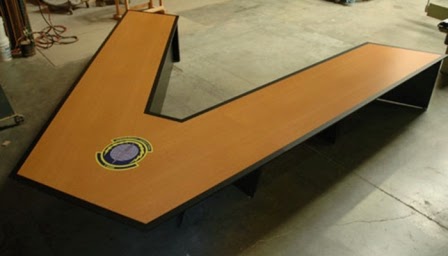
Custom conference table and matching visual aid board for a special client. This is a very good example of the creative design for a custom conference table with a logo to match the clients and an accent on the visual aid board. The custom conference table also incorporates power and data module to fulfill the customers needs. this particular custom conference table mixes wood veneers with hpl laminates for the logo.
Monday, April 21, 2008
LOGO SET
Thursday, March 20, 2008
History of Video Data Conferencing
History of Video Conferencing
Videoconferencing uses telecommunications of audio and video to bring people at different sites together for a meeting. This can be as simple as a conversation between two people in private offices (point-to-point) or involve several sites (multi-point) with more than one person in large rooms at different sites. Besides the audio and visual transmission of people, videoconferencing can be used to share documents, computer-displayed information, and whiteboards.
Simple analog videoconferences could be established as early as the invention of the television. Such videoconferencing systems consisted of two closed-circuit television systems connected via cable. During the first manned space flights, NASA used two radiofrequency (UHF or VHF) links, one in each direction. TV channels routinely use this kind of videoconferencing when reporting from distant locations, for instance. Then mobile links to satellites using special trucks became rather common.
Videoconferencing first demonstrated in 1968This technique was very expensive, though, and could not be used for more mundane applications, such as telemedicine, distance education, business meetings, and so on, particularly in long-distance applications. Attempts at using normal telephony networks to transmit slow-scan video, such as the first systems developed by AT&T, failed mostly due to the poor picture quality and the lack of efficient video compression techniques. The greater 1 MHz bandwidth and 6 Mbit/s bit rate of Picturephone in the 1970s also did not cause the service to prosper.
It was only in the 1980s that digital telephony transmission networks became possible, such as ISDN, assuring a minimum bit rate (usually 128 kilobits/s) for compressed video and audio transmission. The first dedicated systems, such as those manufactured by pioneering VTC firms, like PictureTel, started to appear in the market as ISDN networks were expanding throughout the world. Video teleconference systems throughout the 1990s rapidly evolved from highly expensive proprietary equipment, software and network requirements to standards based technology that is readily available to the general public at a reasonable cost. Finally, in the 1990s, IP (Internet Protocol) based videoconferencing became possible, and more efficient video compression technologies were developed, permitting desktop, or personal computer (PC)-based videoconferencing. In 1992 CU-SeeMe was developed at Cornell by Tim Dorcey et al., IVS was designed at INRIA, VTC arrived to the masses and free services, web plugins and software, such as NetMeeting, MSN Messenger, Yahoo Messenger, SightSpeed, Skype and others brought cheap, albeit low-quality, VTC.
Impact on Video Conferencing Business
Videoconferencing can enable individuals in faraway places to have meetings on short notice. Time and money that used to be spent in traveling can be used to have short meetings. Technology such as VOIP can be used in conjunction with desktop videoconferencing to enable low-cost face-to-face business meetings without leaving the desk, especially for businesses with wide-spread offices. The technology is also used for telecommuting, in which employees work from home.
Telepresence videoconferencing, where participants are able to see each other in reasonable life-like sizes and little delay in video transmissions, has started to make an impact on business meetings. Some good business cases have been built on substitution of international travel with telepresence conferencing.
Videoconferencing is now being introduced to online networking websites, in order to help businesses form profitable relationships quickly and efficiently without leaving their place of work.
Although it already has proven its potential value, research has shown that many employees don’t use the videoconference equipment because they are frightened that they will appear to be wasting time or looking for the easiest way if they use videoconferencing to enhance customer and supplier relationships. To stimulate them in using it, managers should use the technology in front of their employees to take away the fear of using it.
Learn more about video conferencing at Wikipedia.
Franz Design Group - Custom Video Data Conferencing Tables and Office Furnishings.
Data Video Conferencing Resources
- Video Conferencing Guide - A blog on setting up video conferences within your company
- Technical White Paper "High Definition The Evolution of Video Conferencing" PDF
- Video Conferencing Benefits from Hitachi
- Taking the Wraps off Videoconferencing in the U.S. Classroom: A State-by-State Analysis
Wainhouse Research - Alan D. Greenberg
Custom Video Data Conferencing Tables
Franz Design Group.
Franz Conference Table Video
Bob Franz, of the Franz Design Group, discusses what it takes to design you a custom conference table from finishes to video data conferencing
The Franz Design Group
83 Hamilton Drive Suite 104, Novato, Ca. 94949
415.883.9500
From Outside California 877.594.9160
Fax 415.883.9002
Email Bob at: bfranz@franzgroup.com
Video Produced by www.sfbayimaages.com
Friday, February 29, 2008
PROCESS


Creating a custom conference table for a special client....any client thats wants a custom conference table IS a special client, many times this requires special needs. This often may include doing cad-drawings for the purpose of maximizing a custom conference table size. When there are power and data requirements, this often requires coordination between IT people and contractors that have the job of drilling cores for the power and data. We have received many compliments on our response and detail with regards to this aspect, proving detailed explanations of how everything goes together.
The photos show part of the process along with the finished product. All of this hand holding and guiding the process makes for a pleasant experience for our clients. There really is a difference when it comes to creating a custom conference table.